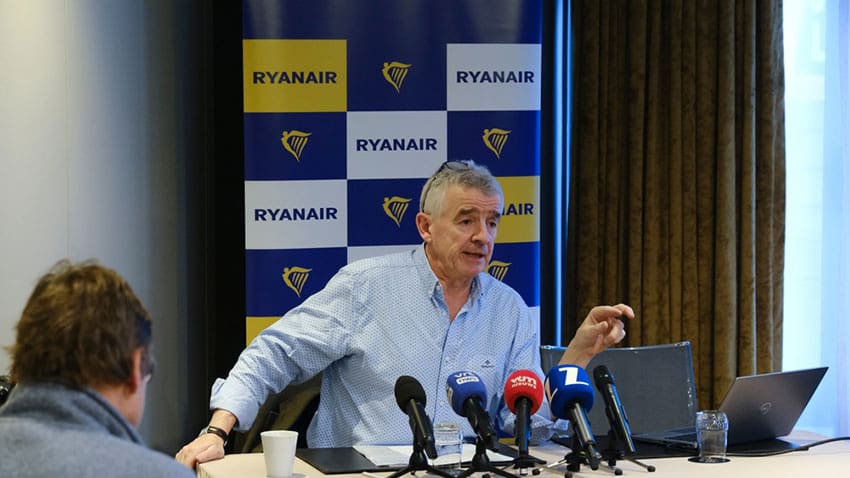
Michael O’Leary, the combative chief executive who turned Ryanair from a small Irish regional operator into Europe’s largest airline, has agreed to stay at the helm until 2032 under a contract whose bonus scheme could be worth more than €150m (around £130m).
The extension keeps one of European aviation’s most recognisable, and most divisive, bosses in post for another six years, and ties the bulk of his potential reward to financial targets that would require the budget carrier to roughly double its profits.
Provided O’Leary remains with the group until April 2032, he would be granted the option to buy 10 million shares at €26.70 each. The options vest only if the airline hits one of two demanding milestones: annual post-tax profit of €4 billion, or a share price above €42 sustained for 28 consecutive trading days.
To put that in perspective, Ryanair last month posted a record full-year post-tax profit of €2.26 billion. Clearing the €4 billion bar would mean almost doubling that figure, which is precisely the point of a long-dated incentive built to reward growth rather than presence.
“Achievement of these very ambitious targets would create substantial additional value for all Ryanair shareholders,” the company said in a statement.
This is familiar territory for O’Leary. Last year he was reported to be on course to collect bonuses worth more than €100m after the budget airline’s shares closed above €21 for a 28th consecutive day in May 2025, meeting a key performance target set years earlier. Business Matters covered that €100m share-option windfall at the time.
O’Leary, now 65, has run Ryanair since 1994. Over those three decades the carrier has grown from a relatively small regional airline into the continent’s dominant low-cost operator, carrying more passengers across Europe than any rival and building a reputation, fairly or otherwise, on rock-bottom fares and an owner who is rarely lost for a quotable line.
That outspoken style has kept him in the headlines well beyond the balance sheet. In recent months he has traded barbs over a mooted takeover and repeatedly attacked UK tax plans even as the airline reported record profits. For investors weighing a six-year extension, that visibility cuts both ways: a chief executive who shapes the narrative, but also one whose departure would leave an outsized gap.
Ryanair group chairman Stan McCarthy said the board had “commenced discussions” with O’Leary in the spring.
“I am pleased to report that this process, which included extensive engagement with Ryanair’s largest shareholders, has successfully concluded with Michael agreeing to extend his leadership of the Ryanair Group for the next six years to April 2032, for the benefit of all shareholders,” he added.
The reference to shareholder engagement matters. Pay deals of this scale routinely attract scrutiny at annual meetings, and structuring the reward around steep, clearly defined targets is the board’s answer to anyone minded to grumble about the headline number. As reported by RTÉ and Bloomberg, the package is explicitly performance-linked rather than guaranteed.
For owner-managers watching from the sidelines, the Ryanair arrangement is a textbook example of succession risk and founder-style leadership writ large. O’Leary is not a founder, but after 32 years he is as close to the company’s identity as any executive in Europe, and locking him in until 2032 buys the board time without resolving the underlying question of who follows him.
The lesson for smaller firms is the one that never dates: incentives should reward the outcomes that build long-term value, and no business, however well run, should be entirely dependent on a single individual at the top.